AI in Cybersecurity: The Double-Edged Sword of 2025
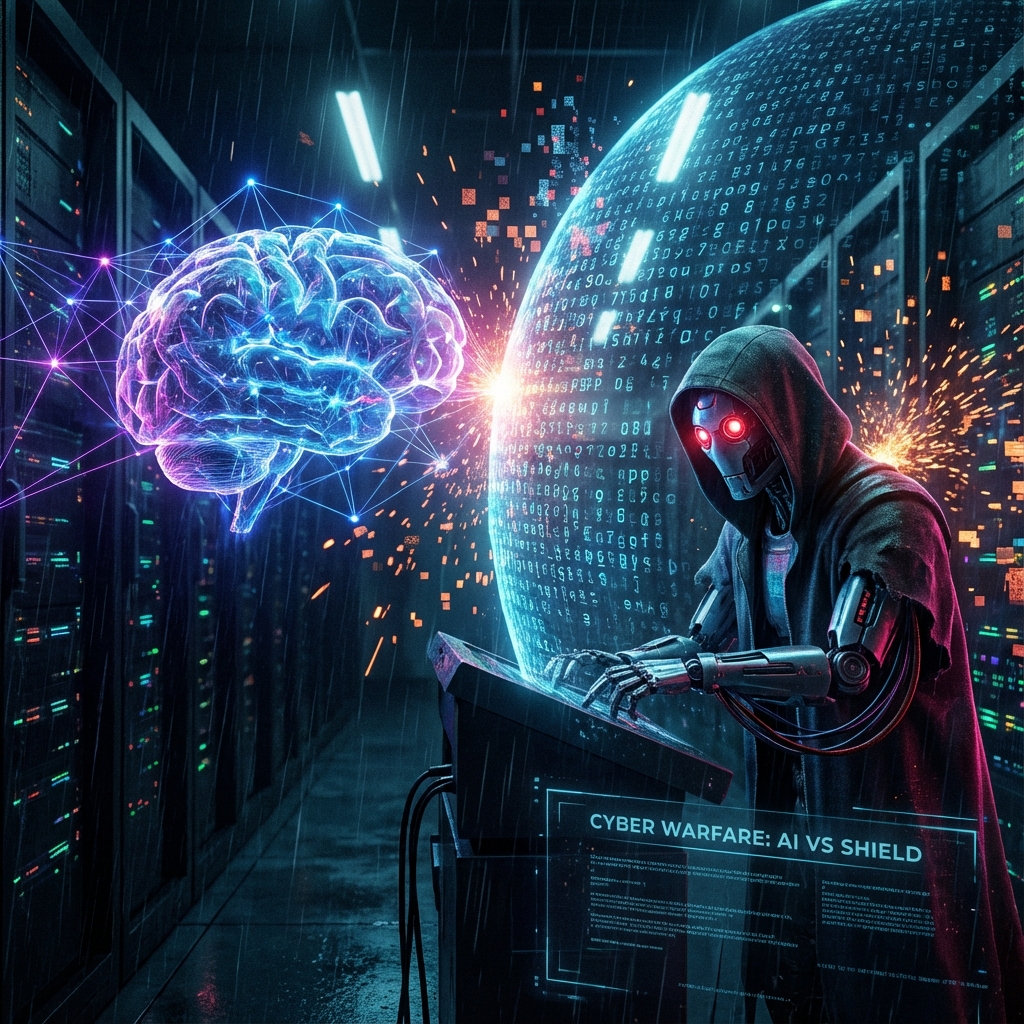
Artificial Intelligence (AI) has revolutionized every industry, and cybersecurity is no exception. In 2025, we are witnessing a digital arms race where both attackers and defenders are leveraging machine learning to outsmart each other. This dual nature of AI presents the most significant challenge and opportunity in modern information security.
The Offensive Side: How Crimes are Automating
Cybercriminals are no longer just lonely hackers in basements; they are sophisticated operators using AI to automate attacks, making them faster, more effective, and harder to detect. Key trends include:
1. Deepfakes & Vishing
Attackers are using Generative AI to clone voices (vishing) and faces to trick employees into authorizing fund transfers or revealing sensitive data. In a recent case, a finance worker was duped into transferring $25 million by a deepfake video conference call involving their "CFO".
2. Polymorphic Malware
Traditional antivirus relies on "signatures" (fingerprints) of known malware. AI-driven malware can rewrite its own code in real-time (polymorphism) to change its structure while keeping its malicious behavior, effectively rendering signature-based detection useless.
3. Smart Phishing at Scale
Large Language Models (LLMs) allow attackers to generate highly personalized, grammatically perfect phishing emails in any language. These emails use social engineering tactics tailored to specific individuals, referencing their recent LinkedIn activity or company news, making them nearly impossible to distinguish from legitimate correspondence.
The Defensive Side: AI as a Shield
On the flip side, security teams are fighting fire with fire. AI is becoming the backbone of modern Security Operations Centers (SOCs):
1. Predictive Analysis
Instead of waiting for an attack to happen, AI analyzes vast amounts of threat intelligence to predict where an attack is likely to originate. It spots subtle anomalies in network traffic—like a user accessing files at 3 AM from an unusual IP—that a human analyst might miss.
2. Automated Incident Response (SOAR)
Speed is critical. AI-powered Security Orchestration, Automation, and Response (SOAR) platforms can isolate a compromised laptop, block a malicious IP, and reset a user's password in milliseconds, stopping an attack before it can spread.
3. Identifying "Shadow AI"
Employees effectively creating data leaks by pasting sensitive company data into public AI chatbots is a growing risk. AI security tools can now detect and block these data exfiltrations in real-time.
The Future: Data Poisoning
As organizations build their own AI models, attackers will try to "poison" the training data to manipulate the model's behavior. Securing the integrity of AI datasets will be a major focus for security engineers.
Conclusion
To stay safe in 2025, organizations cannot rely on manual processes. They must adopt AI-driven security tools to match the speed of attackers. Furthermore, continuous employee training on recognizing AI-generated social engineering is more critical than ever.
Security Toolkit
Providing professional cybersecurity tools for ethical hackers and security researchers.